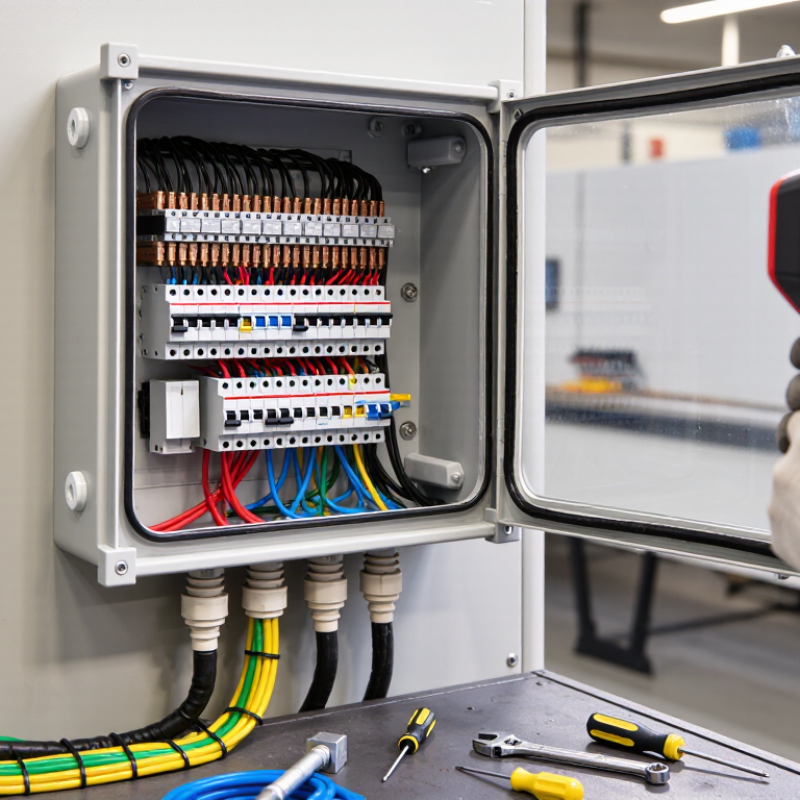
Understanding how does a power distribution box work begins with following the electricity path. Power enters through an incoming cable, then reaches busbars, breakers, fuses, or terminal blocks. These parts divide one supply into several controlled circuits. Each outgoing circuit can feed lighting, machinery, sockets, or temporary equipment. The enclosure protects these connections from accidental contact, dust, and mechanical damage.
A practical inspection often reveals more than a diagram. Loose terminals may create heat, while an overloaded breaker can interrupt production without warning. A properly selected box matches the system’s voltage, current, fault rating, enclosure type, and installation environment. Grounding and bonding also help direct dangerous fault current toward protective devices. Those devices should disconnect power quickly when abnormal current appears. It is not magic.
Technicians usually verify labels, cable sizes, torque settings, and breaker operation before energizing equipment. They may use thermal cameras to identify hot connections during service. However, measurements alone do not prove that every installation is safe. Moisture, vibration, poor maintenance, and inaccurate labeling can change the risk over time. A tidy enclosure may still hide a weak connection. That point deserves reflection.
This introduction explains the operating principle, internal components, protection methods, and maintenance considerations behind modern power distribution boxes. It also separates normal distribution from fault protection, because these functions are related but not identical. Reliable work depends on manufacturer instructions, qualified personnel, and applicable electrical standards. Never treat a distribution box as a simple container for wires. It is a coordinated control point where design quality, installation practice, and regular inspection directly affect safety and performance.
What Is a Power Distribution Box?
A power distribution box is an enclosure that receives electrical power and divides it among several circuits. It creates a controlled connection between one power source and multiple loads. Inside, conductive busbars or terminals route electricity to separate output lines. Each line may supply lighting, tools, machinery, or temporary equipment.
The box usually contains fuses, circuit breakers, or residual-current protection devices. These components help limit damage when a circuit overloads or develops a fault. For example, a breaker may disconnect a 20-ampere outlet circuit before overheated wiring causes trouble. Clear labels also matter. A small label near each terminal can prevent confusion during maintenance.
A properly selected box matches the system voltage, current rating, enclosure rating, and number of outgoing circuits. Outdoor units need protection from moisture, dust, and accidental contact. Ventilation may also be necessary when internal components produce heat. Installation should follow local electrical requirements and be checked by a qualified professional. It is easy to focus only on capacity. That is a mistake. Cable size, grounding, fault protection, and access space are equally important. In real installations, rushed labeling and loose connections remain common weaknesses. A careful inspection can reveal them before the box is energized.
| Data Dimension | Description | Typical Information | Why It Matters |
|---|---|---|---|
| Definition | A power distribution box is an enclosure that receives electrical power from one source and distributes it to multiple circuits or loads. | Commonly used for temporary power, construction sites, events, industrial equipment, and backup-power systems. | It organizes power connections and helps protect people, equipment, and wiring. |
| Basic Operating Principle | Electrical power enters through an input connection, passes through protective devices, and is divided among several outgoing circuits. | Input → main disconnect or breaker → busbars → branch breakers or fuses → output receptacles or terminals. | This arrangement allows each connected load to receive the required voltage while limiting fault currents. |
| Main Input | The incoming connection supplies the total available power to the distribution box. | May be a cable, plug, terminal block, generator connection, or fixed electrical feeder. | The input rating must be suitable for the system voltage, phase arrangement, and maximum current. |
| Voltage Configuration | The box may distribute single-phase or three-phase alternating current, depending on the electrical system. | Typical low-voltage systems operate at approximately 120 V, 208 V, 230 V, 240 V, 400 V, or 415 V, depending on the region and application. | All connected equipment must be compatible with the supplied voltage and phase configuration. |
| Main Disconnect | A switch or circuit breaker that disconnects power from the entire distribution box. | May be a rotary isolator, molded-case circuit breaker, or enclosed disconnect switch. | It provides a convenient method for emergency shutoff, inspection, and maintenance. |
| Branch Circuit Protection | Individual breakers or fuses protect outgoing circuits from overloads and short circuits. | Branch ratings are selected according to the conductor size, receptacle rating, and connected load. | A fault on one branch can be isolated without necessarily shutting down every connected circuit. |
| Residual-Current Protection | A residual-current device detects current flowing through an unintended path, such as a person or grounded enclosure. | Protection sensitivity is commonly 30 mA for personnel protection in many applications, subject to local regulations. | It reduces the risk of fatal electric shock but does not replace proper grounding or overcurrent protection. |
| Busbars and Internal Wiring | Conductive busbars or internal cables transfer power from the input section to the branch protective devices. | Copper or aluminum conductors may be used, with insulation and clearance appropriate to the rated voltage and current. | Correct conductor sizing helps prevent overheating, excessive voltage drop, and insulation damage. |
| Output Connections | Outgoing power is delivered through receptacles, cable couplers, terminal blocks, or hardwired feeders. | Outputs may include standard receptacles, higher-current connectors, or dedicated three-phase outlets. | Different output types allow the box to supply multiple loads with different current requirements. |
| Grounding and Bonding | Protective-earth conductors connect exposed conductive parts to a grounding system. | The enclosure, grounding terminals, and protective conductors are bonded according to the applicable electrical code. | A low-impedance fault path helps protective devices operate quickly during an insulation failure. |
| Enclosure Protection | The enclosure protects internal electrical parts from accidental contact, impact, dust, and moisture. | Indoor units may use metal or polymer enclosures; outdoor units require an appropriate weather-resistant enclosure rating. | The environmental rating must match the installation location and exposure conditions. |
| Load Capacity | The maximum usable output is limited by the lowest-rated part of the system, including the input, conductors, breakers, and connectors. | Portable units may be rated from a few amperes to several hundred amperes; the exact value is shown on the nameplate. | Loads must be calculated to avoid continuous overloading and nuisance tripping. |
| Monitoring Features | Some distribution boxes display electrical measurements and operating status. | Possible measurements include voltage, current, frequency, phase balance, energy consumption, and alarm status. | Monitoring helps identify overloads, imbalance, voltage problems, and abnormal operating conditions. |
| Typical Applications | Power distribution boxes are used wherever one supply must feed multiple protected circuits. | Construction sites, temporary events, workshops, industrial machinery, generators, photovoltaic systems, and emergency power installations. | They improve connection management, portability, circuit isolation, and electrical safety. |
| Safe Installation Practice | Installation and inspection should be performed by qualified electrical personnel in accordance with local regulations. | Verify isolation, ratings, grounding, cable condition, enclosure integrity, and correct breaker operation before energizing. | Electrical systems can cause shock, arc-flash, fire, or equipment damage when incorrectly selected or installed. |
It receives incoming electricity and divides it into controlled branch circuits. Each circuit receives separate protection.
Common parts include an enclosure, busbars, breakers, fuses, terminal blocks, meters, sensors, and a grounding bar. Some boxes also include surge protection and residual-current protection.
Service conductors carry power to the meter and main disconnect. The main breaker feeds busbars, which supply individual branch breakers.
Busbars carry current across the enclosure with lower resistance than scattered cables. Proper spacing and insulation help reduce arcing risks.
Fuses melt when current becomes excessive. Breakers trip during overloads or short circuits and can usually be reset after the fault is cleared.
A larger fuse may let dangerous current continue through undersized wires. That can create excessive heat and a fire hazard. Do not guess.
The grounding conductor provides a safer path during faults. A clean enclosure can still contain a loose grounding connection, so inspection matters.
They show voltage, current, load, and energy use. These readings can reveal uneven phase loading or circuits nearing their rated capacity.
Technicians may find crowded wiring, unclear labels, loose terminals, heat marks, or breakers serving unexpected outlets. The layout may look tidy.
Isolate the power, verify circuits with an approved meter, and inspect conductor size and grounding. Never remove the cover casually; energized parts may remain live.
A power distribution box is a central enclosure that receives electrical energy from a main source and directs it to multiple circuits, allowing equipment and systems to operate safely and efficiently. To understand how does a power distribution box work, it helps to examine its key components, including busbars, terminals, fuses, circuit breakers, relays, and control connections. Incoming power is connected to the main terminals, where it is divided into separate outgoing circuits according to the needs of different devices.
Fuses and circuit breakers help protect wiring and equipment by interrupting current when an overload or short circuit occurs, while relays control the delivery of power to selected circuits. Proper installation requires secure connections, suitable enclosures, correct circuit sizing, and protection from heat, moisture, and vibration. Regular maintenance should include visual inspections, tightening connections, checking protective devices, and replacing damaged components to support reliable and safe operation.

 SN Electrical